
A Second-Source Material Means Retesting Everything? Using IEC TS 62915 to Keep a Whole Product Family Certified with Minimal Samples
Summary: Module makers qualify second and third sources, thin their wafers and trim encapsulant grammage almost every week, and each change can touch an IEC 61215/61730 certificate. Built around IEC TS 62915:2023, this article explains the three yardsticks for deciding whether something counts as a change, the few 'fatal' changes that demand full requalification, the retest menu for common material changes, a junction-box retest matrix, and practical strategies for representative samples and bundled changes.
Behind every IEC 61215/61730 certificate sits a frozen bill of materials. Glass, encapsulant, cells, ribbon, backsheet, junction box, frame — change the supplier, the thickness or the process of any one of them and you face the same question: is the certificate still valid? Get it wrong and you either spend hundreds of thousands on unnecessary retests, or an unreported change surfaces during a customer factory audit or an overseas spot check. This article walks through the rulebook for changes: IEC TS 62915.
01 A certificate freezes a BOM, not a model name
Newcomers often assume a certificate covers a model number. In fact the certification body approves the construction and materials that were tested — the critical-component list in the certification file (often called the CDF or BOM). The model name is just a label for that construction.
IEC 61215-1:2021 explicitly requires retesting after modifications to follow IEC TS 62915. The current version is Edition 2, published in September 2023 (Corrigendum 1 followed in 2024). It keeps the logic of the 2018 first edition while making several important changes: IEC 61215 and IEC 61730 retest requirements are written separately; retest rules for dynamic mechanical load (MQT 20) and PID (MQT 21) are added; Annex A provides a matrix summarising every type of change; the IEC 62788 component-level material standards are referenced; and new clauses cover high-temperature operation (IEC TS 63126) and system compatibility of variants of the same model.
Edition 2 also removed many process-specific change items from the first edition and replaced them with a requirement for a quality management system per IEC 62941. In other words, day-to-day process variation is handled by the quality system; the standard focuses on design and material changes that affect reliability and safety.
Key point: Responsibility sits with the manufacturer: the standard requires the maker to disclose changes in design, materials, components, material combinations, manufacturers and processing, and to supply supporting data. Not reporting is never a cost-saving option.
02 Is it a change? Apply three yardsticks first
When a new material is introduced, the first step is not to look up which tests to run, but to decide whether it counts as a change in the standard's terms. We summarise the logic of Clauses 3 and 4 of TS 62915 as three yardsticks:
- Yardstick 1: is it a 'different material'? A material that differs in chemical composition, type designation or specification (including nominal values and tolerances of electrical, optical and mechanical properties) is a different material. The same material from another supplier or site is not necessarily different, as long as equivalence can be clearly demonstrated.
- Yardstick 2: the initially tested value is the reference. Thickness and dimension comparisons always use the originally tested value. A new value within the nominal tolerance is not a change; outside it, it is.
- Yardstick 3: if tolerance exceeds the trigger, test the worst case. If the declared tolerance is itself larger than the percentage that triggers a retest (e.g. a 10% glass thickness reduction), samples at the worst-case tolerance limit must be tested.
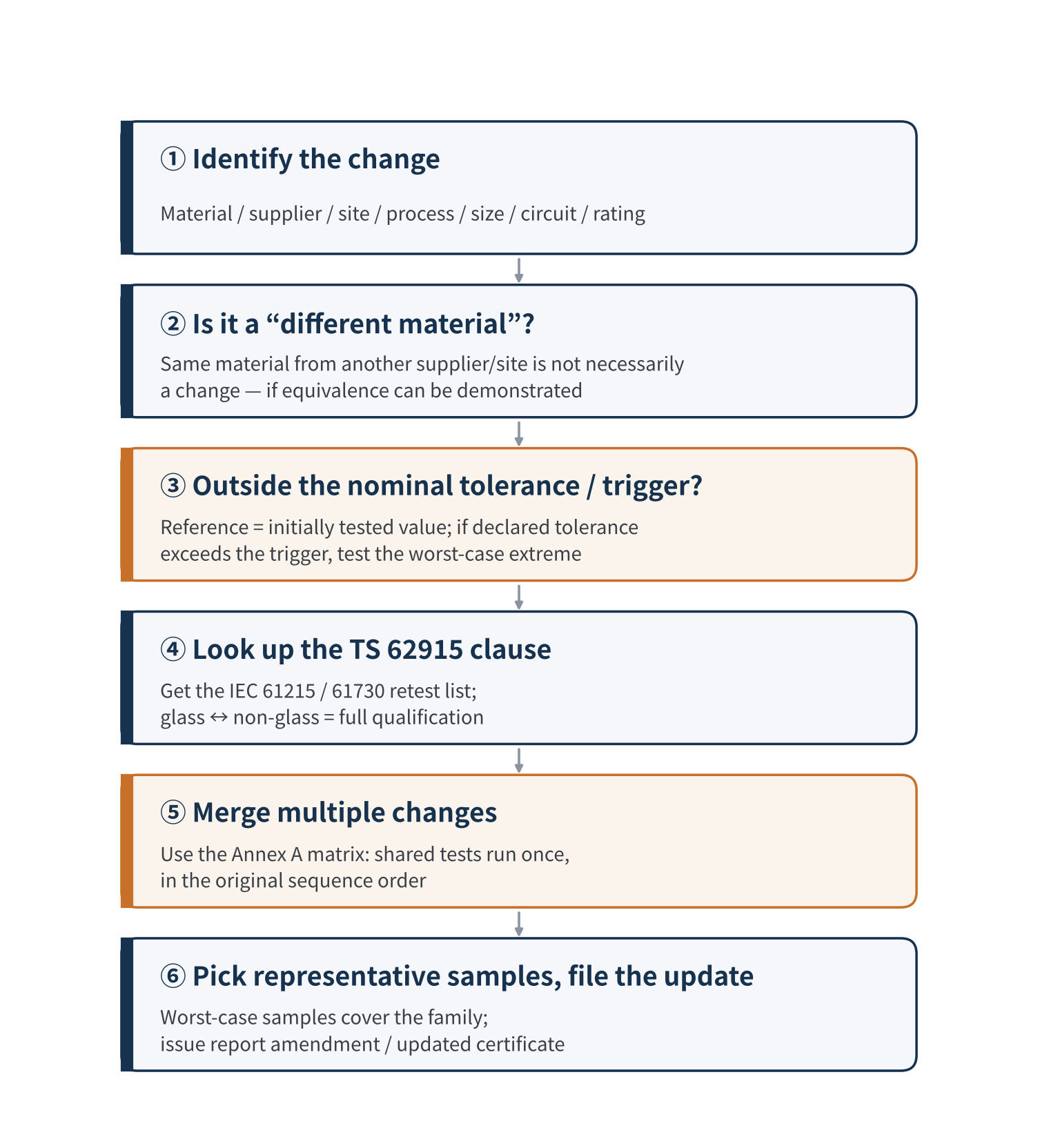
Figure 1. BOM change decision flow (compiled from Clauses 3 and 4 of IEC TS 62915:2023)
Yardstick 3 is a common trap. To avoid future filings, some makers declare very wide tolerances, only to be told on the first submission to test the thinnest, lightest extreme — which raises the certification bar instead. How wide to set a tolerance should be decided together with real material capability and cost headroom.
03 What counts as a 'fatal' change?
Cases that require starting over with full qualification are actually few. The clearest one in the standard is switching the frontsheet or backsheet between glass and non-glass — for example from glass-glass to glass plus transparent backsheet, or vice versa. That is effectively a different module construction, and no partial retest can cover it. For thin-film modules, a change of semiconductor material or technology also requires full qualification.
Another group of changes is not formally 'full requalification', but the retest list is so long that in practice we treat them as near-fatal:
- System voltage increase. Edition 2 draws the line at more than 5%. It triggers hot-spot, UV/TC50/HF, TC200 and DH, plus a long list of safety tests such as insulation thickness, impulse voltage and accessibility, and IEC 61730 Sequence B.
- Monofacial to bifacial. Edition 2 adds a dedicated clause (4.2.17). Rear-side irradiance changes the current and temperature envelope of the module; it is no longer a simple material substitution and must be checked item by item against the clause.
- Higher operating-temperature level. Modules qualified to temperature level 1/2 under IEC TS 63126 run several tests at higher temperatures; results from the standard-temperature version cannot simply be reused.
- Entirely new material combinations. Two directly contacting materials never tested together must be assessed under the combination rules in Annex A.
Bottom line: What fatal changes have in common is that they change the module's construction type or its operating envelope, not the brand of one material. A new brand usually means a partial retest; a new construction means full qualification.
04 The retest menu for common material changes
Most everyday changes fall into partial retests. The key is to know each change's trigger threshold and the matching test package. The chart below summarises common quantitative thresholds: exceed them and you retest; stay within them and you only update the file and keep the evidence.
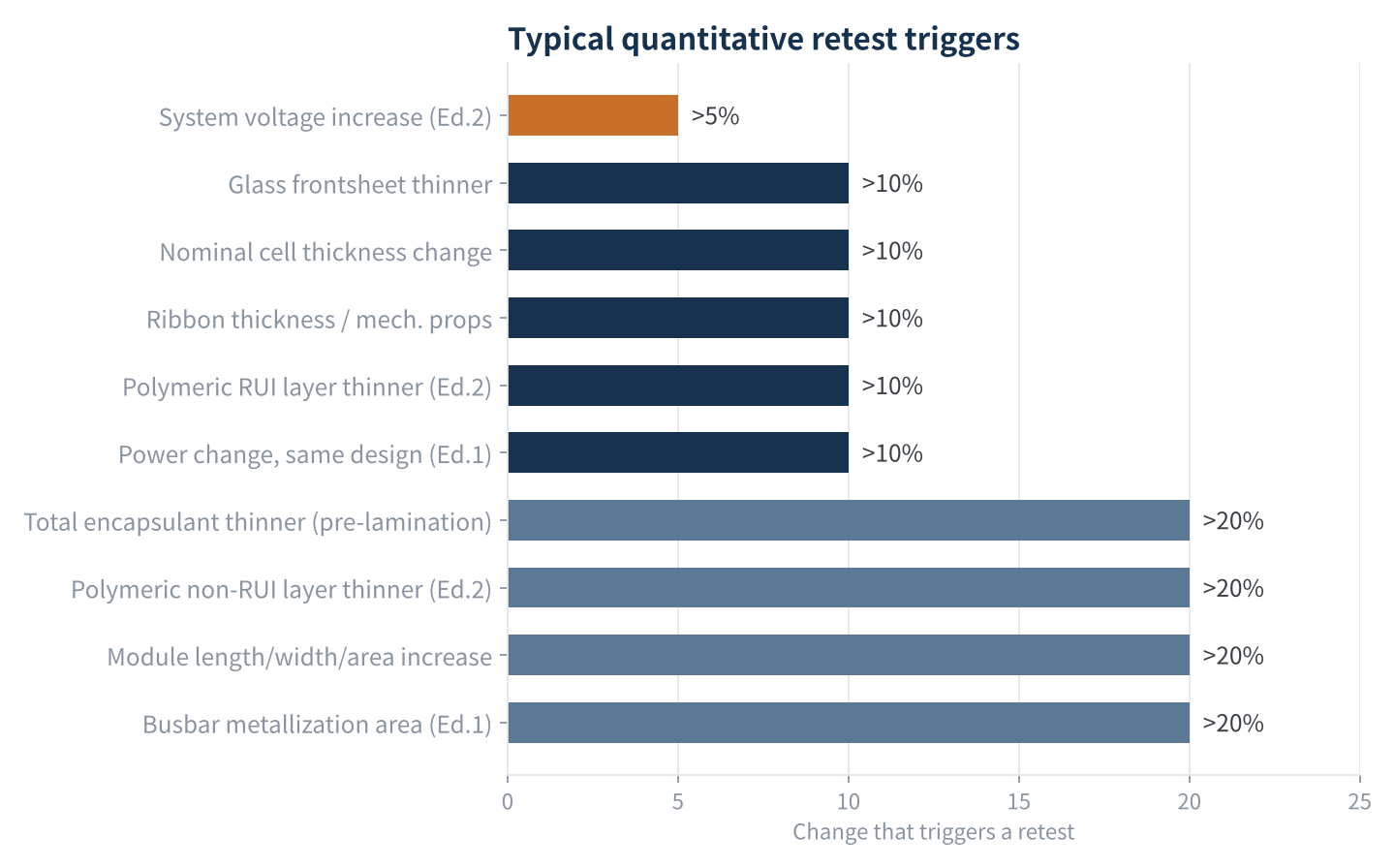
Figure 2. Retest triggers for common quantitative changes (items marked Ed.2 are from the 2023 edition; the rest are from public clauses of Ed.1 — see the data notes)
Mapping thresholds to test packages gives the menu below. It covers wafer-based (WBT) modules on the IEC 61215 side; IEC 61730 safety tests are listed in the references.
| Change | Typical trigger | IEC 61215 retest package (key items) |
|---|---|---|
| Encapsulant | New material/grade/manufacturer, additive or formulation change, lamination process change, total thickness (pre-lamination, may be expressed as grammage) reduced >20% | Hot-spot MQT09; UV+TC50+HF10; DH1000; hail if frontsheet is polymeric |
| Cells | New manufacturer or site outside the same QMS, nominal thickness change >10%, cut-cell format, busbar count, metallization paste, AR coating | Hot-spot; TC200; DH (may be omitted if cell surface chemistry is identical); static load MQT16 for thickness reduction only |
| Ribbon / interconnect | New material, thickness or tensile/yield/elongation change >10%, cross-section change, solder/flux/ECA change | TC200; DH for material change; hot-spot for bonding technique/material change |
| Glass frontsheet | Thinner by >10%, reduced strengthening, coating/surface treatment change | Hot-spot; UV+dynamic load MQT20+TC50+HF10 (omittable if UV cut-off is not lower); static load; hail |
| Frame / mounting | Profile or corner design change, reduced contact area, material or adhesive change, framed to frameless | Static load is central; UV/TC/HF/DH if mounting relies on adhesive; no tests if only the frame supplier changes with identical spec and design |
| Module size | Length, width or area increased >20% | TC200; DH1000; static load; hail if non-tempered glass or non-glass |
Two intuitions are worth building from this table. First, encapsulant and cell changes are the two most expensive: both require DH1000 and long ageing, which alone ties up a climate chamber for over a month. Second, many items carry exemptions — DH can be omitted if the cell surface chemistry is identical, and a pure frame-supplier change needs no tests. The manufacturer must claim these exemptions with data; the certifier will not apply them for you.
05 Junction boxes: retesting electrical termination changes
Back to the subject of this series. TS 62915 groups junction boxes, cables and connectors under 'electrical termination'. The prerequisite is that the components themselves meet the standards referenced by IEC 61730-1: IEC 62790 for junction boxes, IEC 62852 for connectors and IEC 62930 for cables. A component certificate only proves the component itself; the reliability of the component combined with the module must still be verified at module or component level.
Junction-box changes fall into four groups: box material or design (size, position, number of boxes), potting compound, mechanical attachment (mainly the adhesive), and electrical attachment (soldering, crimping, brazing). Each group triggers a different test set. We compiled the public Ed.1 clause into a matrix:
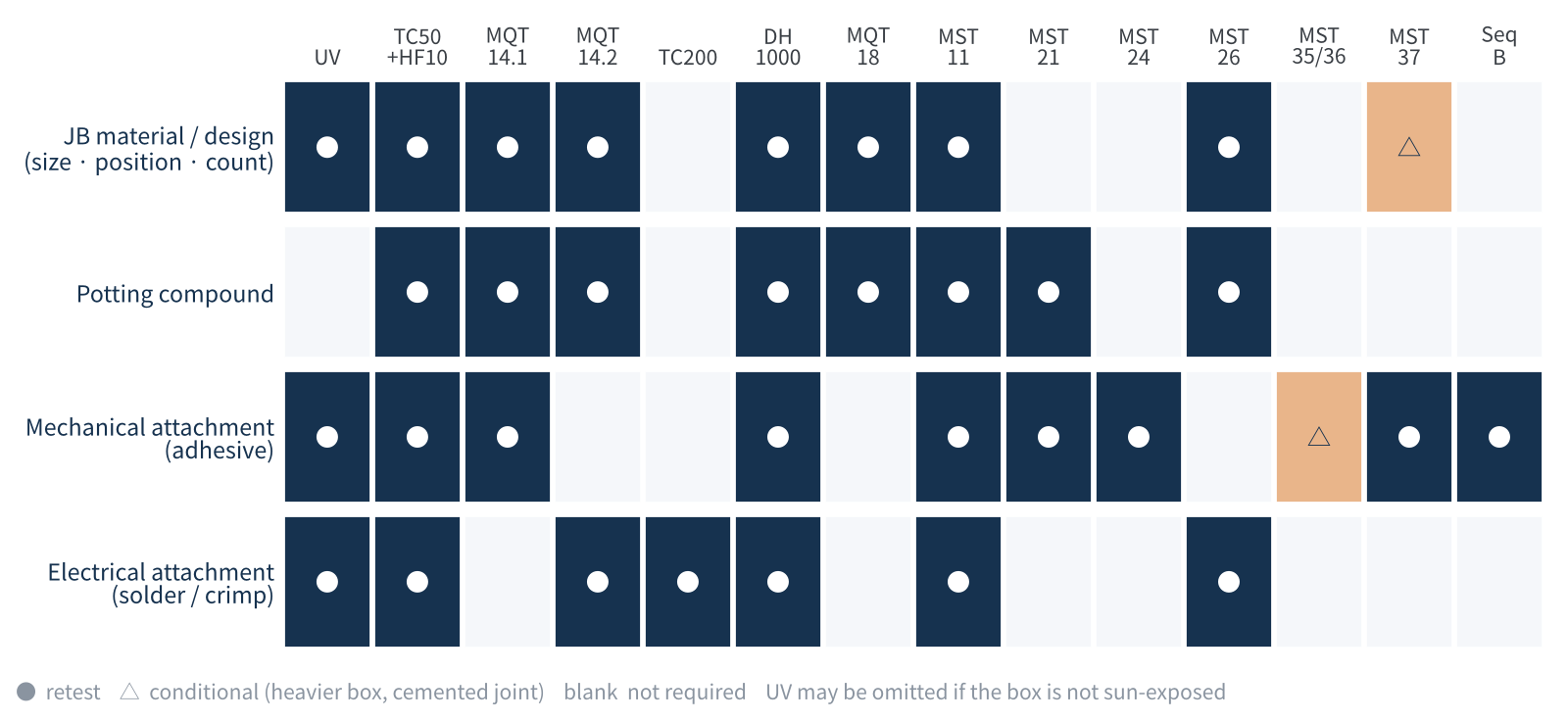
Figure 3. Retests for the four groups of junction box (electrical termination) changes (compiled from IEC TS 62915 Clause 4.2.6)
- Changing the adhesive triggers the most tests. Besides TC50+HF10 and DH, it brings in the temperature test, ignitability, creep and IEC 61730 Sequence B, because the adhesive decides whether the box stays on under heat and humidity.
- Changing the electrical attachment adds TC200. Moving from solder to crimp makes thermal fatigue the main risk, so only this group calls for 200 thermal cycles. IEC 61215-1:2021 also requires weights to be hung on the junction box during TC200, amplifying this risk.
- A new potting compound can skip UV. Potting sits inside the box away from direct sunlight, so UV preconditioning can be omitted; but the temperature test is needed because potting directly affects diode heat dissipation.
- When bypass diodes sit inside the box, the diode requirements follow IEC 62790; a change of attachment method alone does not require repeating the bypass diode thermal test MQT18.
Key point: When qualifying a second-source junction box, the easiest path is: the box already holds an IEC 62790 certificate, the adhesive and potting stay on certified grades, and the connection method is unchanged. That usually lands in the 'box material/design' row only; once the adhesive changes too, the test load rises sharply.
06 Family grouping: covering many variants with few samples
Knowing what to test is only half the story; the real savings come from how many samples and which variants. TS 62915 explicitly allows representative samples, with the detailed rules in Annex A.3 of IEC 61215-1:2021 — what the industry calls family grouping. In practice we use five tactics:
- Choose worst-case representatives. Within a family, use the largest size and weakest frame for mechanical load, the highest-current variant for hot-spot and diode tests, and the thinnest configuration for encapsulant and glass. Only if the worst case passes are the others credibly covered.
- Bundle changes into one submission. If a second-source encapsulant, a second-source junction box and thinner wafers arrive in the same quarter, merge them with the Annex A combination matrix so shared tests run once; tests within one sequence must run consecutively in the original order.
- Lead with material-level data. Edition 2 brings in the IEC 62788-1/-2 series, so makers can use material-level data to justify reduced module-level testing, for example for frontsheet/backsheet model designation. The stronger the data, the fewer module retests.
- Design tolerance windows up front. Plan nominal values and tolerances for grammage and thickness at first certification, so future cost-down moves stay within tolerance instead of hitting a trigger every time.
- Agree engineering judgement early. TS 62915 itself says a degree of engineering judgement is needed. Aligning the change plan with the certifier before submitting samples is far cheaper than retesting afterwards.
Public records offer a ready example: in a TÜV IEC 61215 test report for a leading module maker, a new cell type was brought under the existing certificate by retesting only a representative model under the cell-change clause of TS 62915 — hot-spot, TC200 and the bypass diode thermal test.
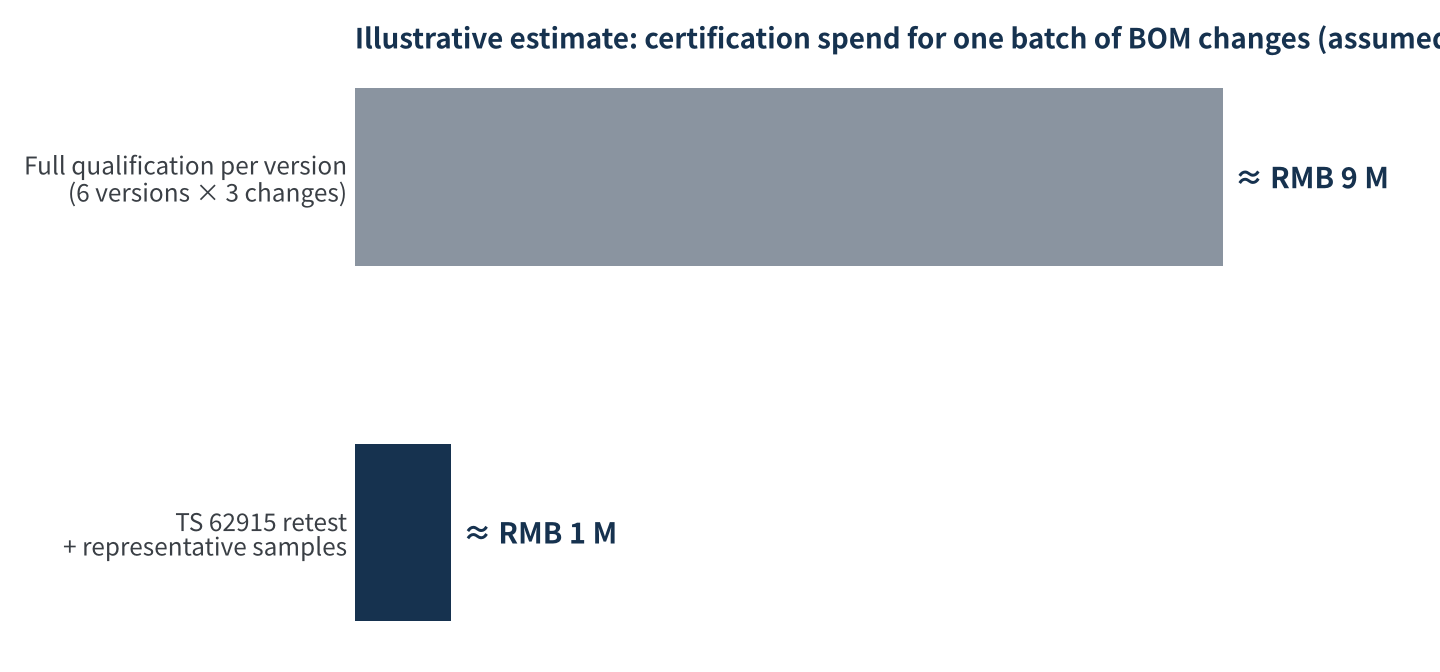
Figure 4. Illustrative estimate: full qualification per variant vs. TS 62915 retest plus representative samples for the same batch of changes
A rough calculation using the assumptions in the data notes: with 6 variants and 3 simultaneous changes, treating every change as a new model with full qualification could cost around RMB 9 million; running only the relevant TS 62915 packages on two worst-case representative sample sets costs roughly RMB 1 million. The millions saved are not a loophole — they are a path the standard explicitly provides.
07 Final thoughts
At its core, IEC TS 62915 offers a documented middle path between the high cost of retesting every change and the high risk of changing without reporting. Using it well takes three steps: decide whether something is a change with the three yardsticks; get the minimum test package from the relevant clause; then cut the test load with representative samples and bundled changes.
Remember the boundaries too: fatal changes such as switching between glass and non-glass cannot be avoided, and concealing changes is never an option. The freedom the standard gives manufacturers rests on proactive disclosure, supporting data and a sound quality system.
Next in the junction box series, we look at stand-alone IEC 62790 certification of the junction box: what a component certificate proves, and what it does not.
Calculation notes / data scope
Thresholds: items marked Ed.2 (system voltage >5%, polymeric front/backsheet RUI layer thinner by >10% or ±5 µm, non-RUI layer thinner by >20%) are from the public table of contents and clauses of IEC TS 62915:2023. Other thresholds and the junction box matrix are from public clauses of Ed.1 (2018); Ed.2 keeps the same clause framework with some detail changes. For formal use, refer to the purchased current text and your certification body's interpretation.
The cost estimate is illustrative. Assumptions: a combined IEC 61215+61730 full qualification costs about RMB 500k per model; retest packages for encapsulant, junction box and cell changes cost about RMB 200k, 150k and 150k per representative sample set. Full qualification per variant = 6 variants × 3 changes × RMB 500k = RMB 9M; TS 62915 route = (200k+150k+150k) × 2 representative sets = RMB 1M. Real prices vary widely by lab, sample count and scheduling; substitute your own quotes.
The table is a summary of IEC 61215-side key tests only; it does not list all IEC 61730 safety tests or every exemption.
References
- IEC TS 62915:2023 Photovoltaic (PV) modules – Type approval, design and safety qualification – Retesting, Ed.2.0 (incl. COR1:2024)
- IEC TS 62915:2018 Ed.1.0 (public preview, Clauses 4.1–4.2.15)
- IEC 61215-1:2021 / IEC 61215-2:2021 Terrestrial PV modules – Design qualification and type approval
- IEC 61730-1:2023 / IEC 61730-2:2023 PV module safety qualification
- IEC 62790 Junction boxes for photovoltaic modules – Safety requirements and tests
- IEC 62941:2019 Terrestrial PV modules – Quality system for PV module manufacturing
- IEC TS 63126:2020 Guidelines for qualifying PV modules, components and materials for operation at high temperatures
- TÜV Rheinland IEC 61215 test report for a leading module maker (representative-sample retest under IEC TS 62915 Clause 4.2.3), publicly available
PV Materials Lab
PV Materials Lab (光伏新材料研究所)
A PV R&D and engineering team with 10+ years of experience | In-depth technical knowledge sharing
Materials · Reliability · Failure Analysis · Standards & Certification · Products · Processes
Exploring AI + PV — collaboration welcome
Disclaimer:
- Original content reflects the authors' personal views, is for reference only and does not constitute investment advice.
- Reproduced and cited content is attributed to its source.
- Some content is AI-assisted (chart generation, data retrieval, concept explanation); the core framework and key content were written by our technical team and reviewed by humans.
- If anything is inaccurate or infringing, please leave a message or contact us.