
Can Thermoplastic Encapsulants Rescue Recyclability? The Standards Tug-of-War between Creep Resistance and Dismantling
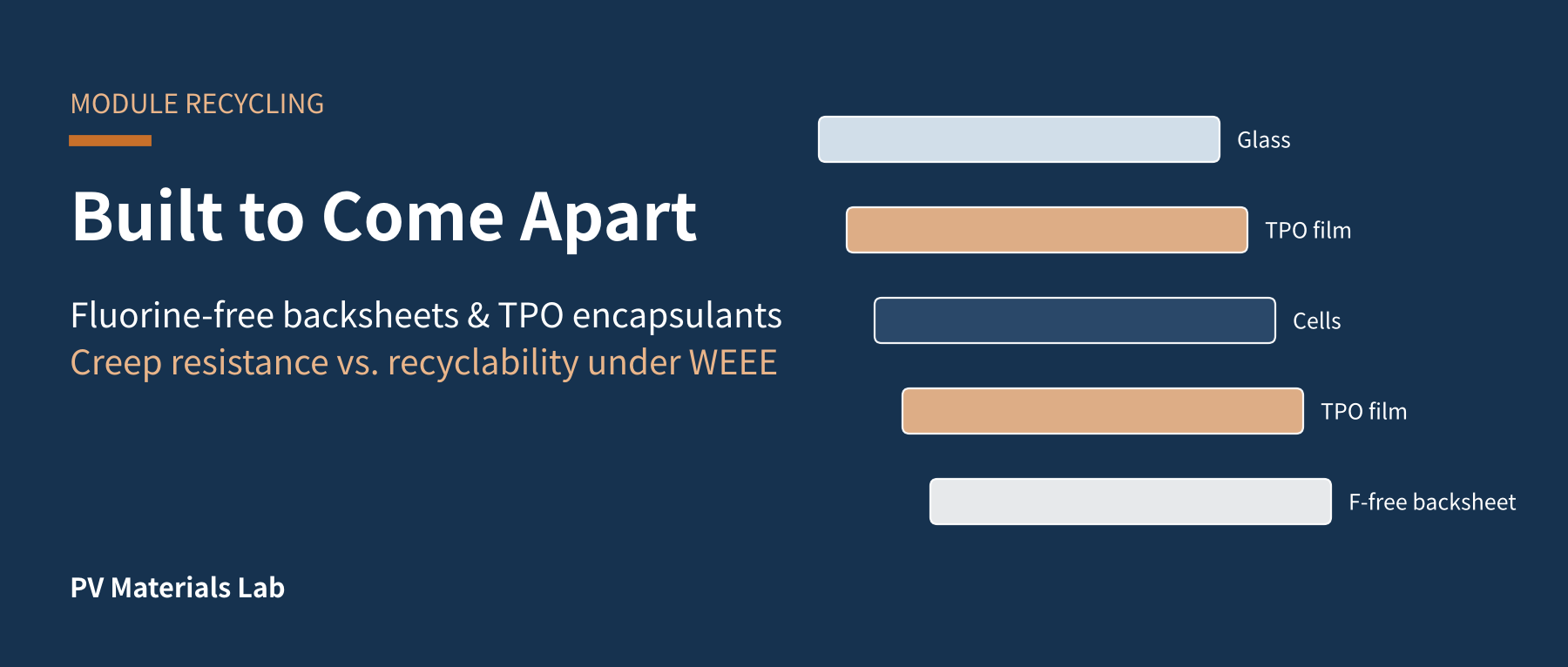
With the EU WEEE revision and the Circular Economy Act approaching, the bar for PV exports is shifting from 'can it be collected' to 'can it be taken apart'. Today's 85% target is weight-based: glass plus the aluminium frame nearly meet it, while hard-to-recover silver and high-purity silicon are not measured at all. We unpack three technical bottlenecks: crosslinked EVA/POE encapsulants that resist delamination, fluorinated backsheets that release HF during pyrolysis, and non-crosslinked TPO encapsulants that separate easily but must pass the IEC 61730-2 MST 37 creep test. Creep resistance and recyclability are fighting over the same temperature window.
For the past two years, the export conversation in PV has centred on carbon footprint. In the EU, however, a second yardstick is being sharpened: whether an end-of-life module can be taken apart, and whether its silver and high-purity silicon can be fully recovered. By the end of 2026 the European Commission must decide whether to revise the WEEE Directive, and the Circular Economy Act (CEA) is already on the calendar. In this article we look at it from the materials side: why crosslinked encapsulants and fluorinated backsheets are recycling bottlenecks, and why thermoplastic polyolefin (TPO) encapsulants are caught between the creep test and recyclability.
01 The rules are shifting: from 'collected' to 'dismantled'
PV modules are not new to the EU WEEE system. Directive 2012/19/EU has covered them since 2012, under category 4 'large equipment', with targets of 85% recovery and 80% preparation for reuse and recycling.
The catch is that both figures are weight-based. In a typical crystalline-silicon glass-backsheet module, glass accounts for about 76% and the aluminium frame about 8% — together nearly 85% (Figure 1). In other words, removing the frame and selling crushed glass gets you most of the way to compliance, while the valuable but hard-to-extract silver and silicon are not measured at all.
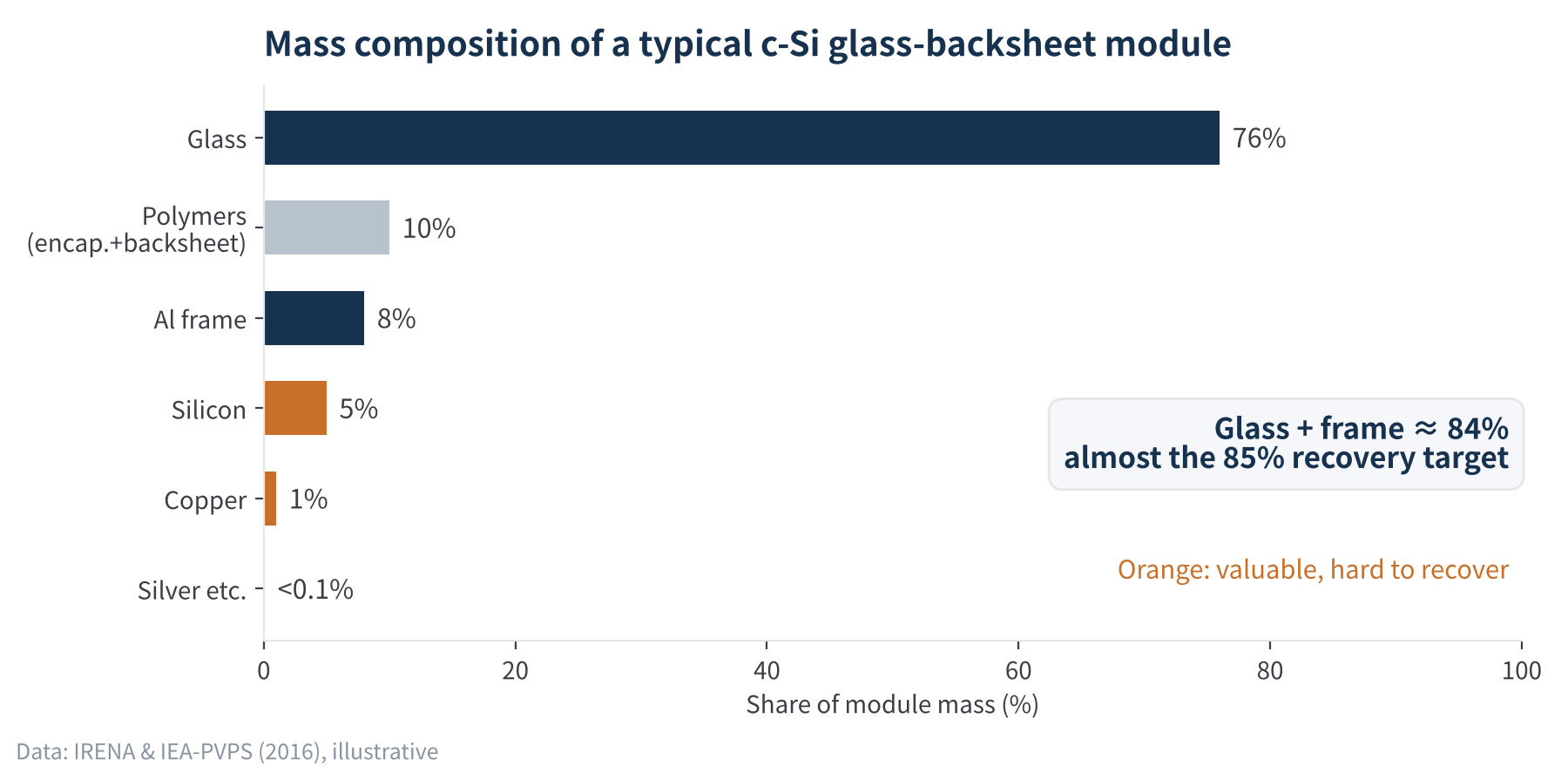
Figure 1 Mass composition of a typical c-Si module: glass + frame almost fill the 85% target
That is the gap the next revision aims to close. Amending Directive (EU) 2024/884 added a review clause: by 31 December 2026 the Commission must assess whether to revise WEEE, explicitly considering a separate category for PV panels, collection targets based on waste panels available for collection rather than units placed on the market, and a mechanism to cover end-of-life costs if a producer goes bankrupt. The Commission has confirmed the WEEE revision will be part of the Circular Economy Act; according to trade press, the proposal is provisionally scheduled for 11 November 2026.
Meanwhile, ecodesign rules for PV are also moving. Draft ideas published by the Commission include disclosing critical raw material (CRM) content on the module or in its manual, and developing a recyclability index for PV products that scores service-related, dismantling-related and material-related criteria.
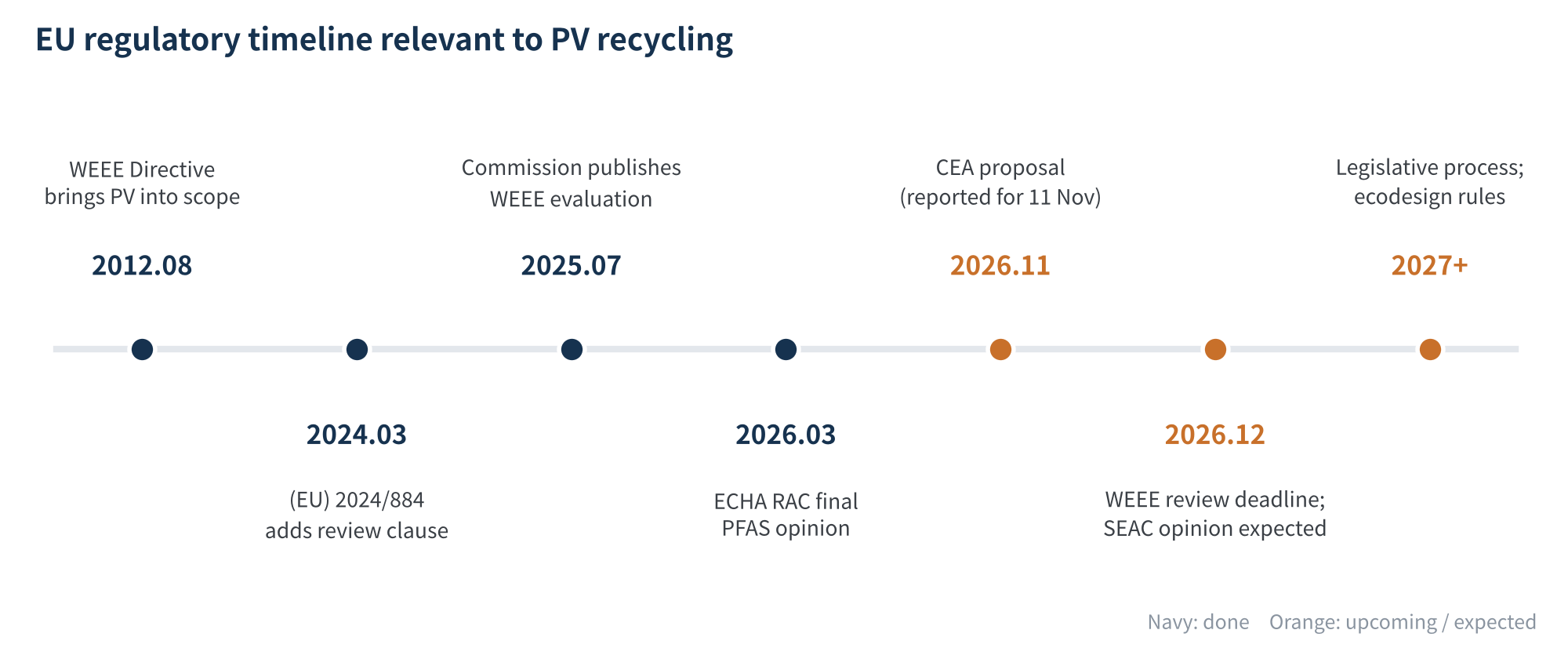
Figure 2 Timeline of relevant EU regulation (as of October 2026)
Summary
To be precise: there is currently no standalone EU 'dismantlability certificate'. Rather, dismantlability is gradually becoming a market-access requirement through the recyclability index, information requirements and new WEEE targets — the easier your BOM is to take apart, the higher your score.
02 Crosslinked encapsulants: the step that 'welds' the module shut
Module recycling usually runs in three steps: removing the frame and junction box, separating the layers (delamination), and extracting materials. Steps one and three are well established; the bottleneck is the middle one.
The reason is the encapsulant. EVA and most POE films are crosslinked by peroxides during lamination, forming a three-dimensional network. Once crosslinked, they neither melt nor readily dissolve, locking glass, cells, ribbons and backsheet together like cured glue — the very source of 25-year reliability, and the very problem for recycling. Each mainstream separation route carries a cost:
- Mechanical crushing: lowest cost, but glass, silicon, silver and polymer end up mixed; glass is downcycled and silver/silicon purity is limited.
- Pyrolysis/incineration: around 500°C removes most EVA, and one study fully separated a POE glass-glass module after 1 hour at 500°C in air. The price is energy, plus hazardous gases when the backsheet contains fluorine.
- Solvent swelling: keeps cells relatively intact, but cycle times are long and solvent recovery and environmental pressure are significant.
| Separation route | Effect on Ag/Si recovery | Main bottleneck |
|---|---|---|
| Mechanical crushing | Mixed fractions, low purity | Glass downcycling, polymer contamination |
| Pyrolysis (~500°C) | Fairly clean glass and cells | High energy; HF from fluorinated backsheets |
| Solvent swelling | Cells largely intact | Long cycles, solvent cost and EHS |
| Thermal peel of thermoplastic film | Low-temperature delamination, potentially whole-cell recovery | Must be balanced against creep resistance |
Table 1 Comparison of the main module delamination routes
03 Fluorinated backsheets: the 'HF trap' in pyrolysis
If crosslinked encapsulants are 'impossible to open', fluorinated backsheets are 'unsafe to burn'. Fluoropolymers in KPK (PVDF/PET/PVDF) and TPT (PVF/PET/PVF) backsheets have a C–F bond energy of about 490 kJ/mol, higher than C–H (about 420 kJ/mol); they are hard to decompose and their decomposition products are troublesome.
Experiments and a life-cycle assessment by Fraunhofer UMSICHT reached a clear conclusion: pyrolysis of PVDF/PVF backsheets produces large amounts of hydrogen fluoride (HF), and the pyrolysis oil contains fluorinated hydrocarbons, so pyrolysis is not a viable end-of-life route for fluorinated backsheets, whereas fluorine-free PET-based backsheets perform better environmentally in both incineration and pyrolysis scenarios. A 2026 Chinese molecular-dynamics study further found that co-pyrolysis of EVA with PVDF enhances HF generation and release, more strongly at higher temperatures — and in practice encapsulant and backsheet cannot be fully separated.
According to the literature, the backsheet is about 3% of module weight (roughly 0.4 kg/m²). Small as that share is, it decides whether a whole pyrolysis line needs HF-resistant materials and alkaline off-gas scrubbing, directly raising recycling cost.
There is regulatory uncertainty too. In the EU universal PFAS restriction proposal, fluoropolymers remain in scope but with numerous time-limited derogations; ECHA's Risk Assessment Committee adopted its final opinion in March 2026, the Socio-Economic Analysis Committee's final opinion is expected by end-2026, and only then will the Commission table a formal proposal. For exporters, a fluorine-free backsheet or a glass-glass design is an insurance policy on both fronts: recycling and PFAS.
04 The appeal of TPO: it melts apart — and might flow away
If crosslinking is the root of the problem, the obvious answer is not to crosslink — to use a non-crosslinked thermoplastic polyolefin (TPO) encapsulant. It softens and melts when heated, so in principle glass and cells can be peeled apart at one to two hundred degrees Celsius without a 500°C pyrolysis furnace. Researchers at UPNA and CENER in Spain compared common encapsulants with a hot-knife method and found TPO the easiest to remove from glass.
The flip side is creep. Thermoplastics flow slowly at high temperature: on a tilted installation, the weight of the glass can make the front sheet slide relative to the back, shifting cell strings and shrinking insulation distances — a safety issue. That is why IEC 61730-2 includes the materials creep test MST 37: the module is held at a specified high temperature for 200 hours and checked for layer displacement and continued insulation compliance.
The test temperature itself has evolved. Earlier practice used 105°C; the newer edition ties the temperature to the module's 98th-percentile operating temperature. For example, the test report format issued by India's BIS under IEC 61730-2:2023 records an MST 37 applied temperature of 90°C, and modules rated to high-temperature Level 1/2 per IEC TS 63126 are tested correspondingly higher.
Earlier NREL work offers an instructive result: most thermoplastic encapsulants showed very little creep in hot outdoor exposure, thanks to high melt viscosity, cooler module edges, and the fact that many materials crosslink spontaneously as they age; the material that crept noticeably was EVA formulated without peroxide. In 200-hour step-stress tests, however, TPOs with lower flow-transition temperatures began to show measurable displacement at around 100°C (Figure 3).
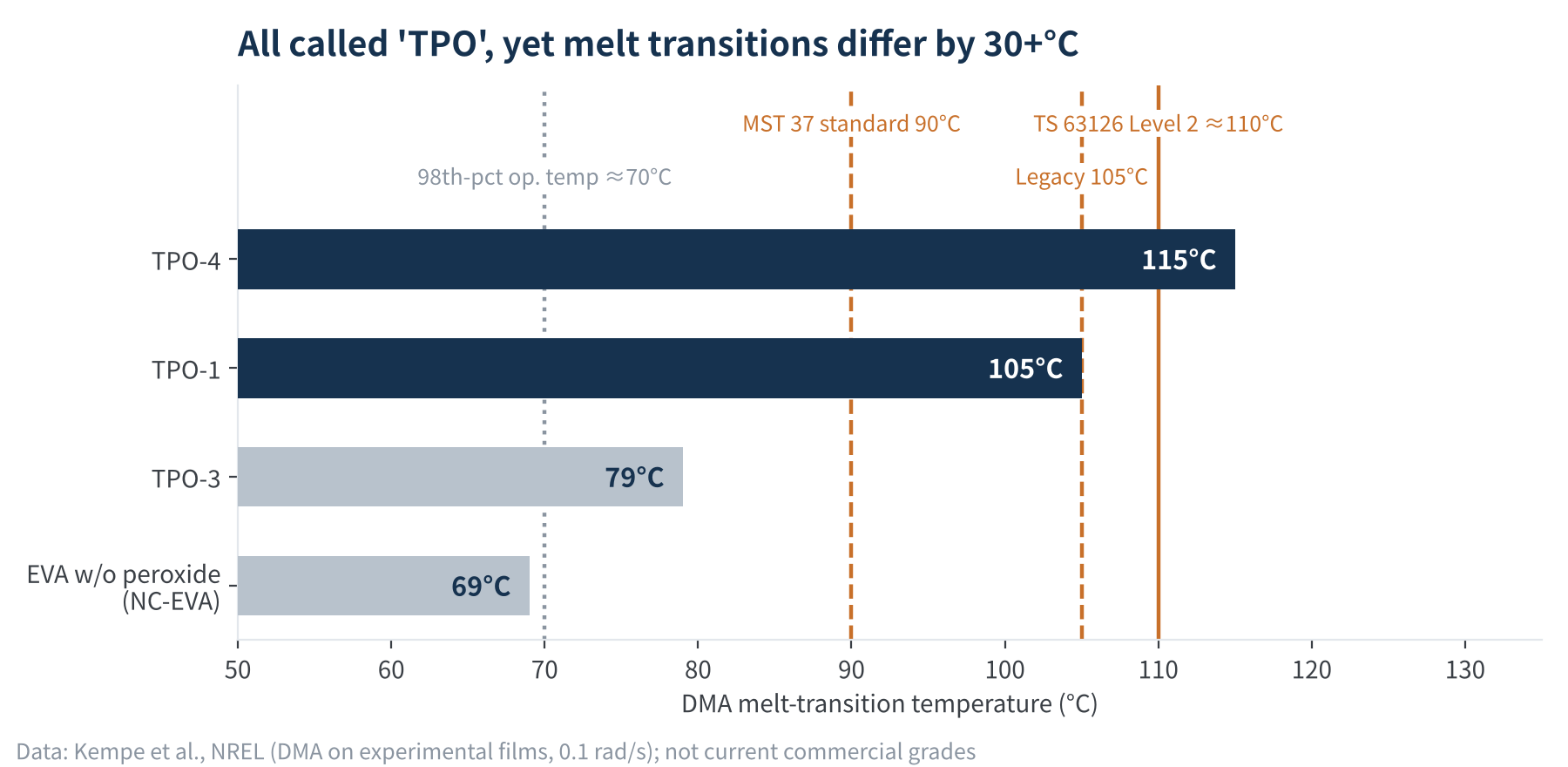
Figure 3 DMA melt-transition temperatures of encapsulants vs. creep-test temperatures
05 The standards tug-of-war: creep resistance and recyclability want the same temperature
Put everything on one temperature axis and the conflict becomes obvious (Figure 4):
- In service: the 98th-percentile module operating temperature is about 70°C, while MST 37 tests at 90°C or even 105–110°C — the encapsulant must hold firm there.
- At end of life: we want the encapsulant to release at around 150–200°C, avoiding the 500°C pyrolysis zone and staying well clear of the range where fluorinated backsheets release HF.
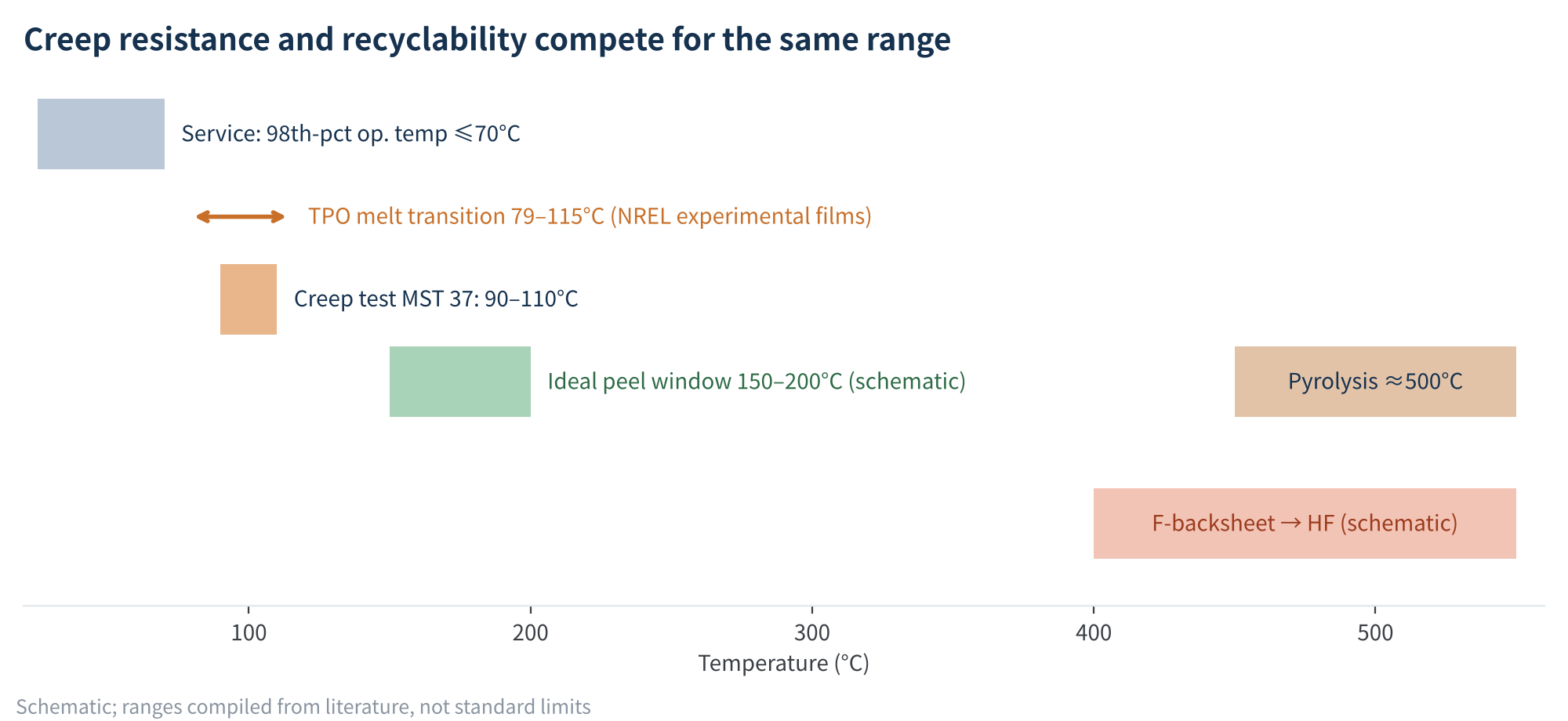
Figure 4 Temperature windows across service, testing and recycling (schematic)
To satisfy both ends, a TPO needs a melt window that is high enough and narrow enough: the flow transition must sit above the creep-test temperature with margin, while the peel temperature must not be so high that the benefit disappears. Figure 3 shows that materials all called 'TPO' can differ by more than 30°C — the label 'TPO' guarantees nothing; grade and formulation are what matter. We see three broad technical directions:
- High-melting TPO: push the flow transition above 110°C to pass creep testing at high-temperature levels.
- Reversible or cleavable crosslinking: a network in service that can be broken thermally or chemically at end of life, e.g. dynamic covalent bonds or cleavable epoxy systems — mostly still at lab stage.
- Structural restraint: glass-glass construction, frames and edge seals together limit interlayer sliding; NREL also showed that restraint from the backsheet further suppresses creep.
The tug-of-war at the standards level is that reliability standards only ask 'will it flow?', while recyclability assessment only asks 'is it easy to take apart?' — and the two currently talk past each other. A 200-hour, single-temperature creep test can hardly represent 25 years of accumulation, and the recyclability index is still in its methodology and calibration phase, with no clarity yet on whether encapsulant type will be scored separately. Whoever first puts both data sets into the same material specification will have a voice in the next round of rules.
Bottom line
The fight over recyclability is really about writing 'durable' and 'dismantlable' into the same material specification.
06 Final thoughts
For module and material makers serving the European market, we offer three practical suggestions:
- Document the BOM first: compile the content and location of fluorine, lead, silver and silicon along CRM-disclosure lines now, so the data is ready the day a recyclability index applies.
- Fluorine-free needs two balance sheets: one for recycling and PFAS compliance, one for weathering, PID and other reliability — don't look at the first alone.
- Test TPO beyond the minimum: in addition to standard MST 37, add creep at high-temperature levels, step-stress and post-ageing creep, and measure peel temperature and peel force on the recycling side.
Recycling is not an after-sales service at the end of a module's life; it is a specification that belongs in the design phase. In the next article we will cover the other half of module recycling: how silver and high-purity silicon are actually extracted, and which of the hydrometallurgical, electrochemical and physical separation routes is closest to mass production.
Calculation notes / data basis
- Figure 1 mass shares are from IRENA & IEA-PVPS (2016) for a typical c-Si glass-backsheet module; glass-glass, thin-glass and newer designs differ considerably — illustrative only.
- Melt-transition temperatures in Figure 3 are DMA results on experimental encapsulants by Kempe et al. (NREL) and do not represent specific commercial grades today.
- The recycling-peel and HF-release ranges in Figure 4 are schematic ranges compiled from the literature, not standard limits.
- The CEA publication date reflects trade-press reports as of 30 October 2026; the official EU release prevails.
References
- Directive 2012/19/EU (WEEE) and amending Directive (EU) 2024/884, EUR-Lex.
- European Commission. Evaluation of Directive 2012/19/EU on WEEE, SWD(2025) 184, July 2025.
- EUWID. Circular Economy Act proposal expected on 11 November, October 2026.
- Eversheds Sutherland. EU WEEE Directive Reform: Tighter Rules, Rising Costs, 2026.
- European Commission. Ecodesign & Energy labelling requirements for PV (draft presentation), 2025; Espinosa et al. A Recyclability Index for Photovoltaic Modules. Adv. Energy Sustain. Res., 2026.
- Fraunhofer UMSICHT. End-of-Life Pathways for Photovoltaic Backsheets, 2017; Aryan et al. Toxics, 2019, 7(3): 47.
- Zi J. et al. Interaction mechanism between EVA and fluorine-containing backsheets during pyrolysis disposal of waste PV modules. Clean Coal Technology, 2026, 32(6): 137–145.
- ECHA; CHEM Trust. Universal PFAS Restriction status, 2026.
- Kempe M.D. et al. Field testing of thermoplastic encapsulants in high-temperature installations. Energy Sci. Eng., 2015; NREL. Testing Protocol for Module Encapsulant Creep, 2012.
- IEC 61730-2:2023; BIS. Test Report Format IS/IEC 61730-2 v2.0, 2026; IEC TS 63126:2025.
- Zubas A.R. et al. Waste Management & Research, 2025 (POE module delamination); pv magazine. Encapsulant delamination behavior in PV glass recycling, September 2025.
- IRENA & IEA-PVPS. End-of-Life Management: Solar Photovoltaic Panels, 2016.
PV Materials Lab
PV Materials Lab
A PV R&D and technology team with 10+ years of experience | Hard-core technical knowledge sharing
Materials · Reliability · Failure Analysis · Standards & Certification · Products · Processes
Exploring AI + PV — collaboration welcome
Disclaimer:
- Original content reflects the authors' personal views only, is for reference, and does not constitute investment advice.
- Reposted and cited content is attributed to its source, with respect for original work.
- Some content is AI-assisted (chart generation, data retrieval, concept explanations); the core framework and key content are written by our technical team and reviewed by humans.
- If anything is inaccurate or infringing, please leave a comment or contact us.