
One Drop of Glue, One Ring of Soft Encapsulant: How 0BB Dispensing Adhesives Poison POE/EVA Crosslinking
Summary: In 0BB modules, the tiny adhesive dots that hold ultra-fine ribbons in place can contain amines, thiols or radical inhibitors. During lamination these diffuse into the surrounding POE/EVA and consume or intercept the radicals from the peroxide crosslinker, leaving a ring of under-cured, sometimes almost uncrosslinked, encapsulant around the ribbon. This article explains the crosslinking mechanism, the three classes of poisoning species, the failure signature and its consequences, and practical detection and prevention methods.
Peel open a 0BB module and you may find that the encapsulant right next to the ribbons dents under a fingernail and strings when pulled, while a few millimeters away it is perfectly fine. Many process and materials engineers have seen this "local mush". The first suspect is usually a bad encapsulant batch, but the real culprit is often the few drops of adhesive used to hold the ribbons in place. In this article we walk through the chemistry and how to troubleshoot it.
01 How one drop of glue can ruin a ring of encapsulant
0BB (zero-busbar) technology removes the busbars from the cell and lets many ultra-fine ribbons conduct current directly across the fingers. Ribbons below 0.2 mm are now common, which raises a practical question: what keeps the ribbons in place before lamination?
One mainstream answer is "soldering + dispensing" or "dispensing + alloying during lamination": a row of tiny adhesive dots is placed along each ribbon, and UV-curing or thermosetting adhesive "pins" the ribbon so it does not drift during lay-up, handling and vacuum. This route can be retrofitted onto existing stringers, which makes it attractive to manufacturers.
Figure 1 shows the typical structure. Each dot is only a fraction of a milligram, apparently negligible next to hundreds of grams of encapsulant.
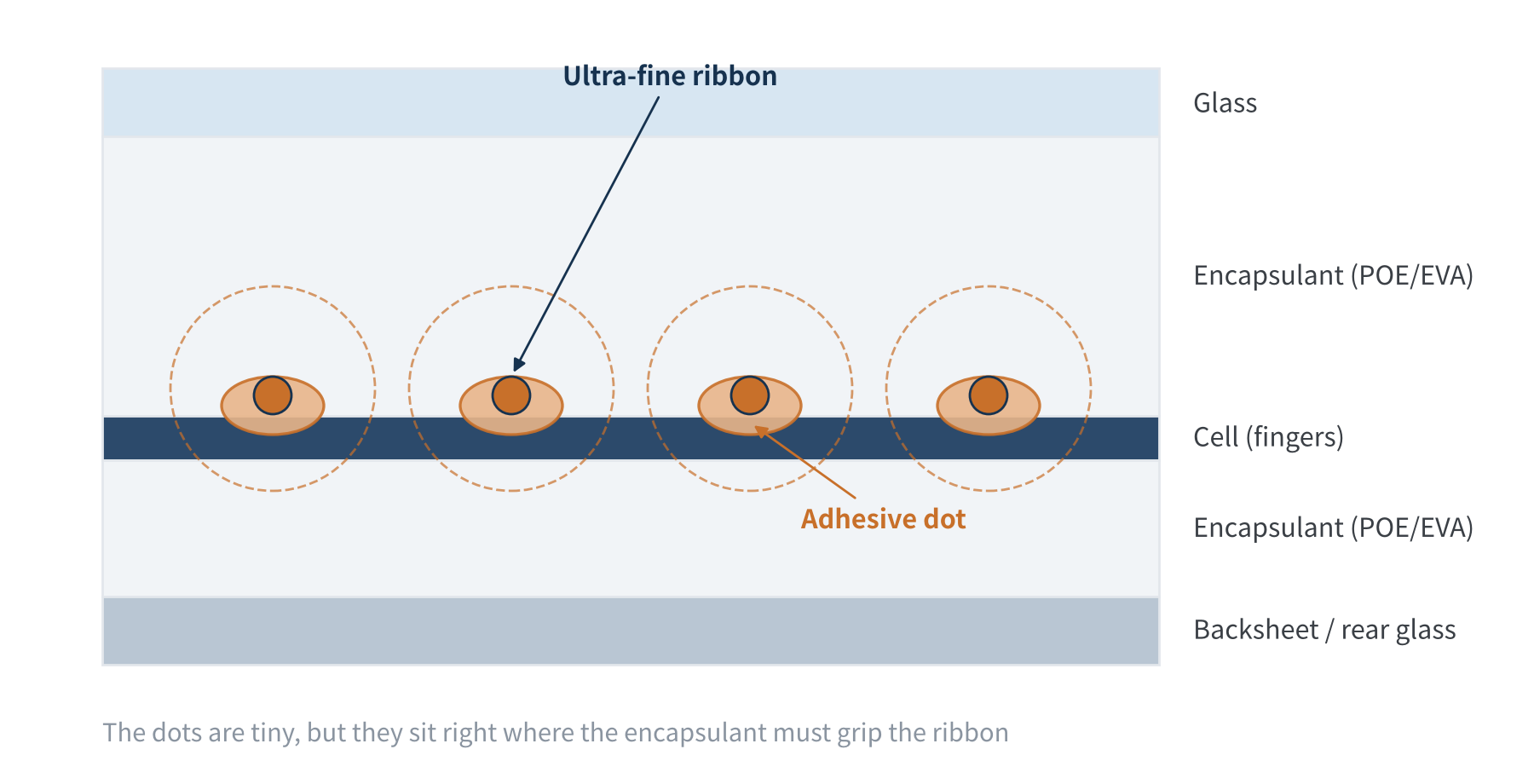
Figure 1 Structure of a 0BB string with adhesive dots before lamination
That is exactly the problem. The dots sit right against the ribbon, which is where the encapsulant most needs to grip. Lamination typically runs at about 145–155 °C, where small molecules in the dots become mobile and diffuse into the molten POE/EVA. If those molecules happen to be enemies of peroxide crosslinking, a ring of under-cured encapsulant forms around the ribbon.
02 How encapsulant crosslinks: a free-radical relay race
To understand "poisoning", start with how crosslinking works. POE and EVA are both thermoplastics; uncrosslinked, they soften and flow when hot. The uncrosslinked fraction of EVA melts at only about 70 °C, a temperature the back of a module easily reaches in summer.
The encapsulant formulation contains an organic peroxide (commonly a peroxycarbonate such as TBEC) as the crosslinker, plus a co-agent such as TAIC. During lamination, crosslinking works like a relay race:
- Start: the peroxide is heated, the O–O bond breaks and alkoxy radicals form;
- Handover: an alkoxy radical abstracts a hydrogen atom from a polymer chain, passing the radical onto the macromolecule;
- Finish: two macroradicals meet and couple into a C–C crosslink; the co-agent helps "run extra legs" and raises efficiency.
The degree of crosslinking is expressed as gel content: the uncrosslinked part is extracted with a solvent such as xylene, and the insoluble remainder is the gel content. Test methods are given in IEC 62788-1-6 and GB/T 29848. Common rules of thumb are above 75% for EVA and above 60% for POE, but the encapsulant supplier's datasheet is what counts.
One key point: POE crosslinks more slowly than EVA to begin with. Rheology studies have found that the more polar EVA gels roughly four times faster than POE. POE's process window is therefore tighter, and if something intercepts radicals along the way, it falls below spec more easily.
Summary
Encapsulant crosslinking is a free-radical relay. Anything that consumes the peroxide, or catches the baton and does not pass it on, breaks the chain.
03 Three kinds of "poison": amines, thiols and inhibitors
By mechanism, the adhesive components that can interfere with crosslinking fall into three groups (Table 1).
| Class | Typical source in the adhesive | How it interferes | Result |
|---|---|---|---|
| Amines | Amine hardeners/accelerators in thermoset adhesives; amine co-initiators in some UV adhesives | Redox reaction with the peroxide "detonates" it early at low temperature, wasting the radicals | Little peroxide left at crosslinking temperature |
| Thiols | Thiol-ene UV adhesives; thiol-cured epoxies | The S–H bond donates hydrogen very easily (strong chain-transfer agent), turning macroradicals into low-activity thiyl radicals | The relay breaks; efficiency collapses |
| Inhibitors / radical scavengers | Phenolic inhibitors (e.g. MEHQ, hydroquinone) added to UV adhesives for shelf stability | Trap radicals directly, forming stable products | Radicals are "eaten" one-for-one; effective peroxide drops |
Table 1 Three classes of adhesive components that can interfere with peroxide crosslinking
First, amines. Tertiary amines form redox initiating systems with peroxides, making them decompose far below their normal decomposition temperature. In room-temperature-curing resins that is an "accelerator"; inside an encapsulant it is premature detonation. Before the film has fully melted and wetted out, part of the peroxide is already gone, and most of the radicals it produced are quenched in unproductive reactions.
Second, thiols. In polymer chemistry, thiols are classic chain-transfer agents, used precisely to control molecular weight and stop chain growth. In a crosslinking system they do the opposite of what we want: once the radical passes to the thiol, it rarely comes back to a polymer chain.
Third, inhibitors. This is the class most often overlooked. UV adhesives cure by free radicals themselves, so formulators add phenolic inhibitors to stop them polymerizing in the container. The cable industry learned long ago that phenolic scorch retarders prevent premature crosslinking at the expense of crosslink density, requiring extra peroxide. Encapsulant research likewise notes that radical-scavenging stabilizers counteract the radicals from peroxide decomposition and affect the final crosslinking state.
There is an amplifier too: if the UV adhesive is not fully cured, residual monomer, photoinitiator fragments and inhibitor migrate more easily. The part of the dot shadowed by the ribbon is exactly where UV exposure is weakest.
04 Why it is always "a ring around the ribbon"
This failure has a strong spatial signature: the affected zone is centered on the dots and runs along the ribbon as a band or a string of beads, while the encapsulant a few millimeters away is normal (Figure 2).
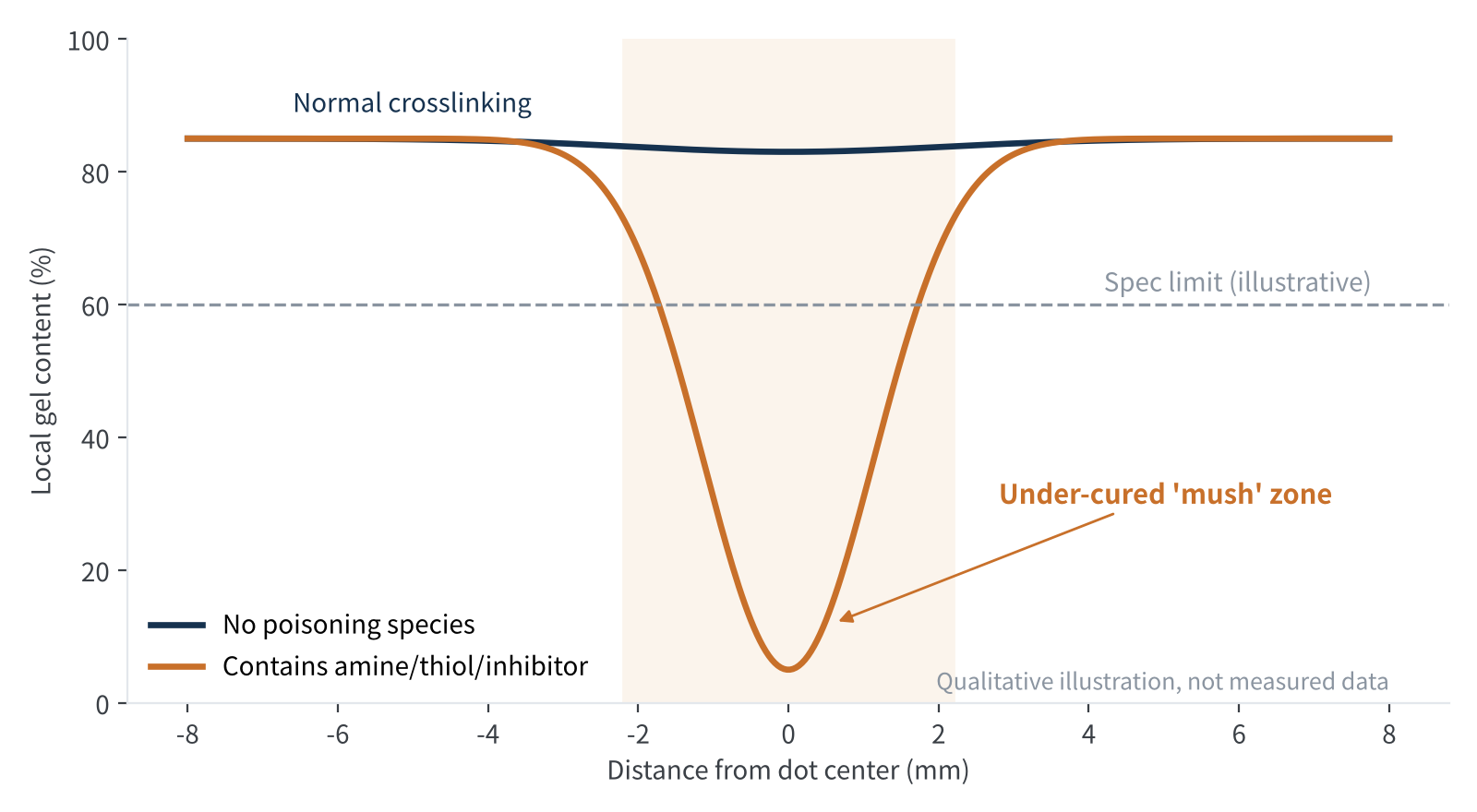
Figure 2 Illustrative gel-content profile around an adhesive dot (qualitative, not measured data)
The reason is simple. The dot is small but concentrated, and diffusion during lamination is limited, so the "poison" concentration is highest near the dot and falls off quickly. The peroxide loading in the encapsulant is designed for uniform crosslinking across the whole sheet, with no margin for heavy local consumption. The result is a low-crosslink zone centered on each dot; in severe cases it barely crosslinks at all and a fingernail leaves a dent.
Location makes the consequences worse, because the area around the ribbon is the most delicate part of a 0BB module:
- Contact retention: in some 0BB routes, ribbon-to-finger contact relies on the encapsulant keeping the ribbon pressed down. If the surrounding encapsulant softens, contact pressure drops, contact resistance rises, and poor contacts or dark EL lines may appear;
- Creep under thermal cycling: under-cured zones soften and flow at high temperature, so ribbons shift more easily during TC;
- Bubbles and delamination: the uncrosslinked fraction can re-melt in later hot operation, forming bubbles and wrinkles and opening a path for moisture;
- Latent risk: initial EL and power can look perfectly normal; problems often surface only after TC, DH or some time in the field.
Key takeaway
The "mush" around the ribbon is often not a bad encapsulant: the adhesive intercepted the peroxide during lamination.
05 How to detect it and how to prevent it
Detection: use comparative sampling to find the culprit. When dispensing poisoning is suspected, the most effective approach is a local gel-content comparison on the same laminate: sample directly above a dot, 1–2 mm beside the ribbon, and far from the ribbon. A clear gradient points strongly in this direction. Supporting tools include DSC for residual exotherm (under-cured zones differ in residual peroxide or exotherm signature) and FTIR comparison of characteristic peaks near the dots.
Quick screening: build a "dispensing compatibility coupon". Before qualifying a new adhesive, laminate a small glass / encapsulant / adhesive dots / encapsulant / backsheet coupon with the normal recipe, then test gel content and peel strength near the dots versus dot-free areas (flow in Figure 3). It is cheap and fast, and we recommend making it mandatory when qualifying dispensing adhesives.
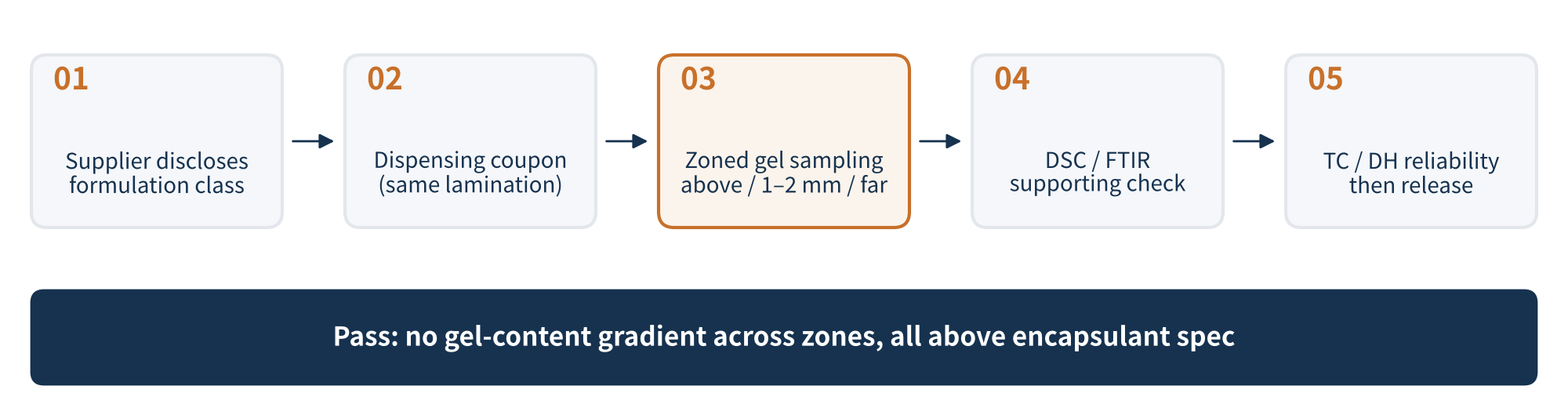
Figure 3 Compatibility check between dispensing adhesive and encapsulant
Prevention: work on the adhesive, the encapsulant and the process.
- Adhesive selection: prefer systems without amine or thiol curing components; ask suppliers to disclose the inhibitor type and approximate level; specify a degree of cure for UV adhesives so the shadowed zone under the ribbon is not under-cured;
- Dose and placement: minimize dot volume and count while keeping enough holding force, and control dispensing consistency;
- Encapsulant co-development: validate jointly with the encapsulant supplier and, if needed, choose a formulation with more crosslinking margin; in EPE and similar structures, the skin layer in direct contact with the dots matters most;
- Process window: use DSC or rheology data to confirm the lamination temperature and time have margin, instead of running at the bottom of the datasheet window;
- Change control: any adhesive formulation change, even just a different inhibitor or co-initiator, should trigger a change notice and a new compatibility test.
06 Final thoughts
0BB keeps making ribbons finer and pushes the materials in a module ever closer together. We used to judge an adhesive by bond strength, cure speed and dispensability; but inside the laminator, the adhesive and the encapsulant are one chemical system, and either formulation affects the other's result.
Material-compatibility problems share one trait: each material passes on its own, failures appear only in combination, and they often show up late. Qualification of a dispensing adhesive therefore cannot stop at testing the adhesive itself; crosslinking compatibility with the encapsulant must be a required check.
Next time, we continue the UV adhesive series with the degree of cure of the UV adhesive itself: how to tell whether it is really cured, and what risks under-cure brings.
References
- SMM. [SMM Analysis] 0BB Technology and Cost of Encapsulation Film for Different Routes (Part 1), 2025-01-05. https://news.metal.com/newscontent/103121370/
- Fraunhofer. DSC study of the interaction of TBEC peroxide, TAIC co-agent and stabilizers in PV encapsulant crosslinking. Fraunhofer-Publica.
- Polymers 2022, 14(7), 1441. Crosslinking kinetics of HALS-modified EVA and POE encapsulants. https://pmc.ncbi.nlm.nih.gov/articles/PMC9003555
- Lust S. et al. Update of quality control tests for new PV encapsulation materials. EPJ Photovoltaics 15, 5 (2024). https://doi.org/10.1051/epjpv/2024006
- NREL. NREL/CP-520-31026, wrinkling and delamination of low-gel EVA under accelerated testing. https://www.nrel.gov/docs/fy02osti/31026.pdf
- US Patent 6656986. Polyethylene crosslinkable composition (phenolic scorch retarders vs. crosslink density).
- US Patent 5354840. Functional-amine polyesters (tertiary amines promote low-temperature peroxide decomposition).
- IEC 62788-1-6; GB/T 29848-2018, EVA film for PV modules.
PV Materials Lab
PV Materials Lab (光伏新材料研究所)
A PV R&D and technology team with 10+ years of experience | In-depth technical knowledge sharing
Materials · Reliability · Failure Analysis · Standards & Certification · Products · Processes
Exploring AI + PV — collaboration welcome
Disclaimer:
- Original content reflects the authors' personal views only, is for reference only, and does not constitute investment advice.
- Reproduced and cited content is attributed to its source, with respect for original work.
- Some content is AI-assisted (chart generation, data retrieval, concept explanations, etc.); the core framework and key content are written by our technical team and reviewed by humans.
- If anything is inaccurate or infringing, please leave a comment or contact us.